
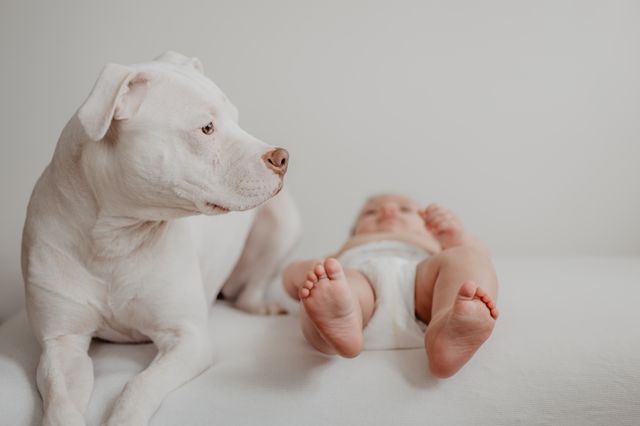
The door opens, and the dog sees his family coming home. But this time, they are not alone. In their arms is a newborn baby — a tiny person the dog has never seen before.
Some dogs immediately come closer. Others stay back and watch. One may bring a toy, another may simply lie down nearby, while another tilts its head as if trying to make sense of this strange new presence.
A dog’s first meeting with a baby can look very different from one dog to another.
Who Is This New Little Person?
For a dog, a newborn is a completely new experience. The baby has a different scent from the adults in the household, makes unfamiliar sounds, and moves differently.
A dog may therefore begin by carefully sniffing the baby, the blanket, or objects associated with the newborn. Smell is an important way for dogs to gather information about their surroundings.
A tilted head, however, does not automatically mean that a dog is “confused” by the baby. One gesture alone cannot tell us exactly what a dog is thinking or feeling.
Every Dog Has Its Own First Reaction
What makes videos of first meetings so interesting is how differently dogs react.
One dog may bring a toy. We should not automatically call it a “gift for the baby” — that is a human interpretation. The dog may simply be carrying a familiar object that interests it in a new situation.
Another dog may lie nearby and quietly watch. A different dog may look completely startled, while another briefly investigates the baby and then goes back to whatever it was doing.
None of these reactions tells the whole story on its own. What matters is the dog’s overall body language and behavior.
A Lot Depends on the Dog’s Experiences
A dog’s response can also be influenced by its temperament, socialization, upbringing, and previous experiences with unfamiliar situations.
A dog that is comfortable with different sights, sounds, and changes may calmly investigate a newborn. A more sensitive or uncertain dog may need more time and space.
That is why it is not a good idea to expect every dog to react like the dogs seen in social media videos.
If a dog moves away from the baby, appears tense, or does not want to come closer, it should not be forced. Dogs Trust recommends allowing the dog to approach at its own pace and ensuring active supervision when a dog and newborn are together. Their guidance on introducing a dog to a new baby is particularly useful for those first moments.
The First Meeting Does Not Have to Be a Big Event
We often imagine the first introduction as a major moment, but in reality it may last only a few seconds.
The dog comes over, sniffs the baby, watches for a moment, and then walks away.
That is perfectly fine.
There is no need for the dog to sit beside the baby for ten minutes or show obvious interest. What matters is giving the dog the opportunity to investigate the new situation calmly and without pressure.
The arrival of a newborn also brings many changes to the household — new sounds, new objects, and a different daily routine. The dog will gradually become familiar with them.
If you are interested in the small things dogs notice about their people, you may also enjoy What Your Dog Notices About You.
The First Meeting Is Different for Every Dog
One dog arrives with a toy. Another lies down. A third stands there looking completely surprised, while a fourth tilts its head.
There is no single “correct” reaction to a newborn.
Each dog comes to that moment with its own personality and experiences.
And perhaps that is what makes these first meetings so fascinating. There is no need to turn them into stories about protection or claim that the dog immediately understands everything about the baby.
Sometimes, we are simply watching a dog meet a new little member of its household for the very first time.
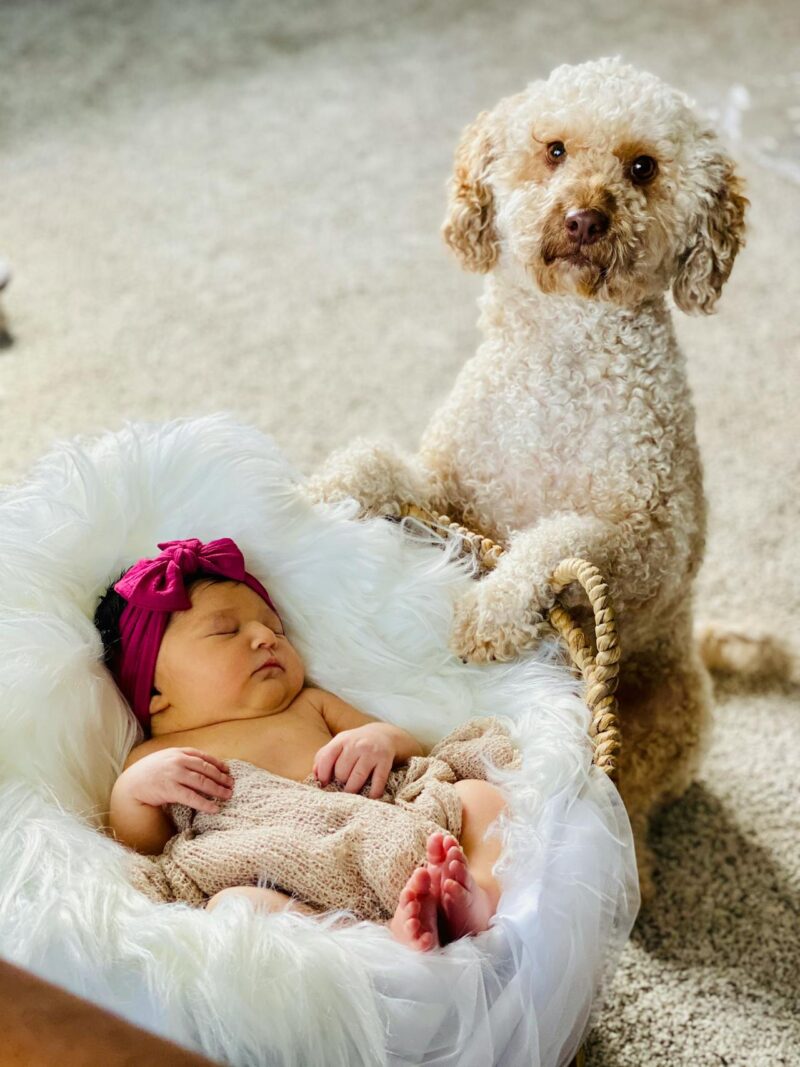
FAQ
How might a dog react when meeting a newborn?
A dog may be curious, calm, cautious, or briefly startled. Every dog can respond differently.
Why does a dog sniff a newborn?
Smell is an important source of information for dogs, so sniffing is a natural way of investigating something unfamiliar.
What if the dog shows no interest in the baby?
That does not necessarily mean anything is wrong. Some dogs investigate briefly and then return to their normal activities.
Is it safe to leave a dog alone with a newborn?
No. Dogs and newborns should always be actively supervised when they are together.
Can a dog get used to a baby gradually?
Yes. The first meeting is only the beginning. The dog will gradually become familiar with the baby's sounds, scent, movements, and the changes to the household routine.